What Is Health Anxiety?
Ever Googled a headache and somehow ended up convinced you have a rare neurological disease? You’re not alone. Health anxiety is when worries about your health become persistent and difficult to switch off. A person may become preoccupied with the possibility that they have—or might develop—a serious illness, even when medical tests and examinations are reassuring.
The problem isn’t simply “I’m worried about my health.” It’s when that worry starts taking over with thoughts “what if doctors or tests have missed something”.
Some signs to look for:
- 👀 Constantly checking your body for new or unusual symptoms
- 🔎 Googling symptoms and going down an endless internet rabbit hole
- 🩺 Seeking repeated reassurance from doctors, family, friends, or even Google
- 🤔 Thinking, “But what if the doctor missed something?”
- 🧪 Getting tests done but still feeling unconvinced by reassuring results
- 🚫 Avoiding activities, exercise, travel, or other situations because of fear of becoming ill
And here’s an important distinction: health anxiety does not mean that your physical symptoms are imaginary. Your body can produce very real sensations—pain, dizziness, palpitations, fatigue, stomach discomfort, and many others. A new or concerning physical symptom deserves appropriate medical attention when necessary. The tricky part begins when uncertainty itself becomes unbearable.
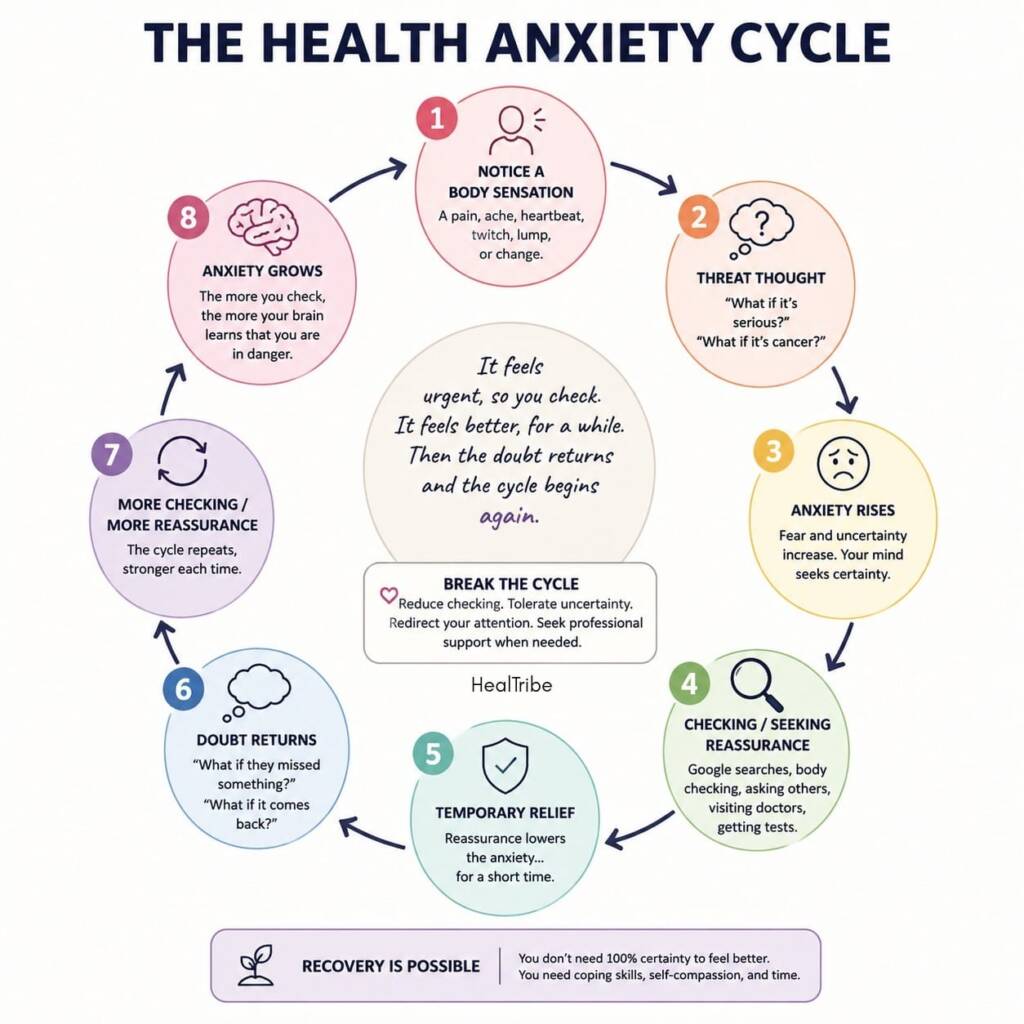
You notice a sensation → worry that something is seriously wrong → check or research → get temporary reassurance → notice another sensation → worry again. And suddenly, you’re stuck in a never-ending game of “What if?”. It isn’t necessary to become 100% certain that nothing bad could ever happen. One should learn to tolerate uncertainty without repeatedly performing behaviours that keep the anxiety alive.
Health anxiety is less about having zero health concerns and more about becoming trapped in a cycle of checking, researching, reassurance-seeking, and trying to achieve 100% certainty about your health—something the human brain simply cannot guarantee. The goal isn’t to stop caring about your health. It’s to learn how to care for your health without letting fear run the entire show.
Clinical note: This article is for psychoeducation and does not replace medical diagnosis or treatment.